
ZARİF HEALTH & LONGEVITY
MUSCLE ISN'T ONLY KEPT IN THE GYM
From the breakfast plate to gut bacteria: the new science of ageing well, at the table
When we talk about long life, we usually think of the heart, the brain, hormones, sleep and genetics. Yet one of the quiet heroes of ageing well is with us throughout our entire lives: our muscles.
Muscle is not simply the tissue that gives the body its shape.
We need it to climb stairs, lift a suitcase, keep our balance, get back up when we fall, carry the shopping, and, as the years go by, go on living our daily lives without depending on anyone else.
What's more, it is not only the amount of muscle that changes with age. Muscle strength can decline faster than muscle mass.
This is why the science of healthy ageing no longer asks only, "How much muscle do we have?"
It asks another question too:
How strong, and how functional, is that muscle?
THE SILENT ORGAN OF A LONG LIFE: MUSCLE
Opening a jar, getting up easily from a chair, pushing a heavy door or climbing the stairs without help may seem like the ordinary movements of daily life.
Yet each of them offers small clues about muscle strength and physical function.
In research, handgrip strength in particular is one of the practical indicators used to assess overall muscle function. Strong associations have been found between low grip strength and poorer health outcomes in later life.
This does not mean that the strength of our handshake tells us how long we will live.
The real message matters more:
Not only the quantity of our muscle, but also its strength and function, are part of ageing well.
And the path to preserving muscle does not run only through the gym.
An important part of the story begins in the kitchen.
IT'S NOT JUST HOW MUCH, BUT HOW YOU SPREAD IT

Protein is one of the essential nutrients for maintaining and renewing muscle tissue.
But as we age, our muscles may not respond to protein as strongly as they did when we were younger. So researchers are now looking not only at how much protein is eaten in total by the end of the day, but also at how that protein is spread across the day's meals.
There is a very familiar pattern in everyday life:
In the morning, a small breakfast that is light on protein.
At midday, a somewhat more substantial meal.
And in the evening, the largest protein portion of the day.
Studies in recent years show that, especially in later life, breakfast is often the day's weakest meal in terms of protein.
So the new approach does not say "eat protein only in the morning".
It says something much simpler:
Don't leave all of the day's protein for dinner.
If breakfast consists only of tea, bread, jam or a few bites, adding a real source of protein to the morning plate can be a good start.
SO HOW MUCH PER MEAL?
In later life, around 25–30 grams of good-quality protein at main meals is one of the commonly used practical ranges for supporting muscle protein synthesis.
But there is an important point here:
30 grams is not a magic number.
Needs can vary with age, body weight, physical activity, overall daily diet, the quality of the protein and a person's state of health.
An essential amino acid found in proteins, called leucine, also plays an important role in stimulating muscle protein synthesis.
But we don't have to turn healthy eating into a calculation of grams and amino acids at every meal.
There is a more useful question for everyday life:
"Is there a real source of protein in each of my main meals?"
Eggs, yoghurt, kefir, cheese, fish, chicken, meat, lentils, chickpeas, beans, tofu and soya products can answer that question at different tables.
WHAT THE SCIENCE SAYS, AND WHAT IT DOESN'T
What does the science say?
Adequate protein is one of the important pieces of muscle health, especially as we grow older.
Spreading protein more evenly across the day, and in particular strengthening a breakfast that is very low in protein, can be a useful strategy.
Working the muscles regularly, meanwhile, is as important as nutrition.
What doesn't the science say?
"If you don't eat protein at a specific time, you'll lose muscle."
"Everyone should eat exactly 30 grams of protein in the morning."
"The more protein you eat, the more muscle you build."
"Eating protein alone is enough to preserve your muscles."
Perhaps the most balanced summary of what we know today is this:
First come an adequate and balanced diet, enough total protein, and movement.
Protein timing and how it is spread across meals are details to consider after that.
THE GUT–MUSCLE AXIS
In recent years, an unexpected new player has joined muscle research:
The micro-organisms in our gut.
We call the ecosystem formed by the vast number of micro-organisms living in the gut the gut microbiota.
These micro-organisms are not concerned with digestion alone. They process certain components of the food we eat, and are in constant interaction with the gut barrier, the immune system, inflammation and metabolic processes.
Now researchers are pursuing a new question:
Could what happens in the gut affect our muscles too?
This possible relationship is called the "gut–muscle axis".
One of the possible links is the short-chain fatty acids that gut bacteria produce as they ferment the fibre in our food.
These substances are known to be associated with maintaining the gut barrier, the immune system and metabolic processes.
There are also studies showing differences in the diversity and composition of the gut microbiota in some people with sarcopenia.
But here, we must not complete the sentence that science has not yet finished.
The gut–muscle axis is an exciting and fast-developing field of research.
However, there is not yet enough evidence to say that the gut microbiota is the sole or main cause of muscle loss.
For now, it is more accurate to see the microbiota as one of the pieces of the larger picture that may affect muscle health.
THE MEMORY OF THE FERMENTED TABLE

This new scientific field is, in fact, no stranger to our kitchens.
Yoghurt.
Kefir.
Some cheeses.
Fermented vegetables.
Tarhana.
People knew how to ferment food long before they knew the word "microbiome".
In one controlled study of fermented foods, the group that increased its intake of fermented foods showed an increase in gut microbial diversity and a decrease in some markers of inflammation.
This result is important.
But we cannot leap from it to the conclusion that "yoghurt builds muscle" or "kefir prevents sarcopenia".
The number and strength of intervention studies in humans are not yet sufficient to say that fermented foods directly increase muscle mass or muscle strength.
So it is more accurate to see fermented foods not as a miracle drug for muscle, but as one of the valuable parts of a varied and balanced table.
What's more, fermented foods are not the only thing that matters for our gut.
The different fibres from vegetables, fruit, pulses, whole grains, nuts and seeds also nourish the gut ecosystem.
Here, too, the magic word is the same:
Variety.
A PROBIOTIC CAPSULE, OR THE TABLE?
As the gut–muscle axis grows more popular, claims that probiotic supplements can increase muscle strength are multiplying too.
Here, science is still cautious.
Although some studies have seen small positive effects of probiotic use on grip strength or physical performance, the results are not the same across all research.
Some of the studies are small, the probiotic strains used differ from one another, and there is not yet evidence strong enough to form a recommendation that holds for everyone.
So, for now, to say:
"Take a probiotic capsule to protect your muscles."
would be premature.
Looking at the table first makes far more sense.
PROTEIN AND THE GUT ON THE SAME PLATE
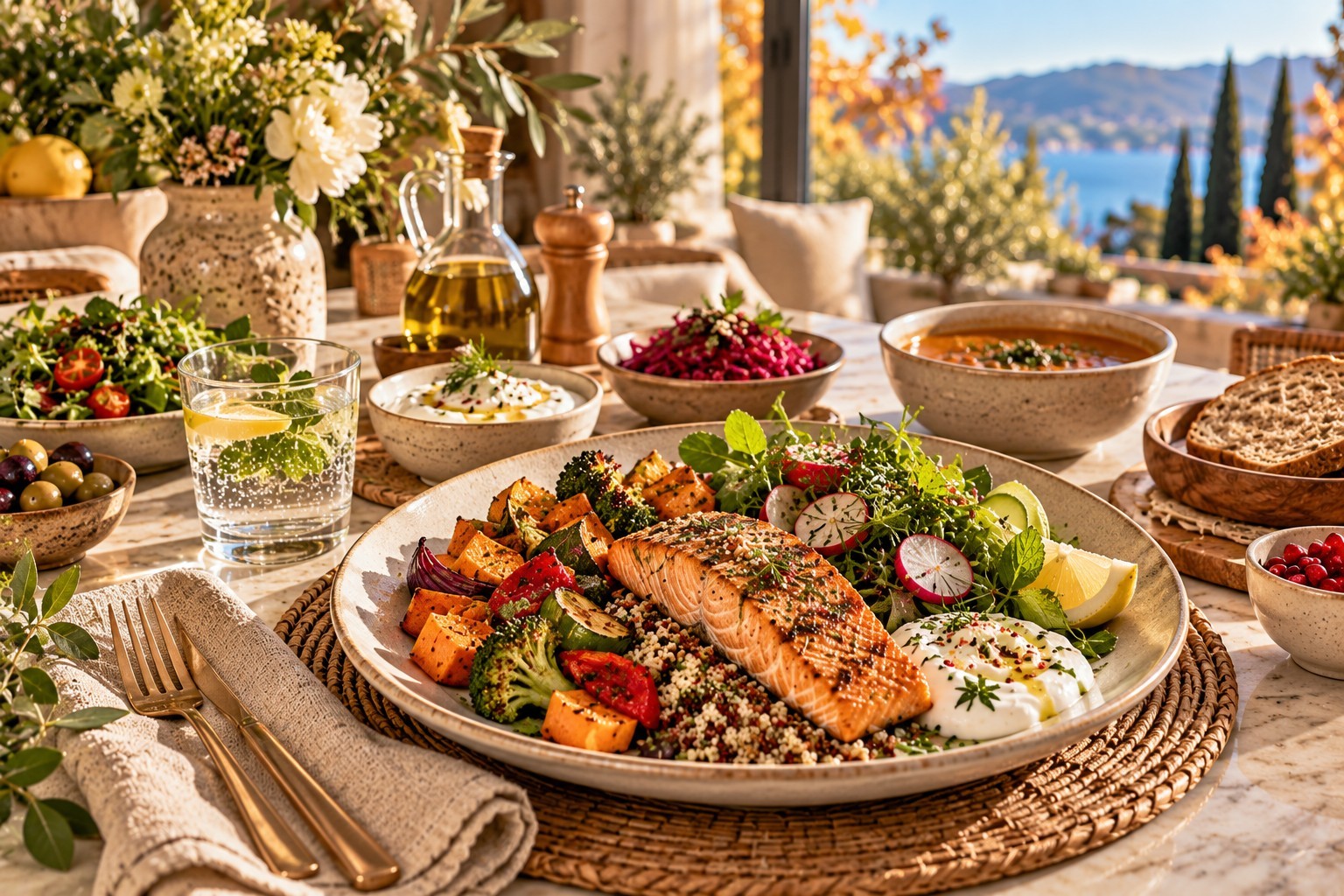
One of the most interesting aspects of new research is that it is beginning to stop treating protein and the gut microbiota as two separate subjects.
In a 12-week controlled study of older adults carried out in 2026, a diet enriched with soya protein was observed to bring some positive results for muscle health, alongside changes in the gut microbiota.
This research opens an important door:
In the future, when we talk about muscle health, we may discuss not only the question "How many grams of protein?", but also the kind of eating pattern in which that protein is consumed.
But a single study does not create a new dietary rule.
So for now, the safest approach is not to separate protein from a gut-friendly way of eating.
For example:
Yoghurt + oats + walnuts + fruit
Eggs + wholegrain bread + plenty of greens
Lentils + yoghurt + a seasonal salad
Fish + vegetables + pulses or whole grains
Tofu + vegetables + whole grains
The idea here is not to create a single "perfect plate".
It is to bring protein, fibre and a variety of plant foods together within the same day.
THE ZARİF BREAKFAST PLATE

What might all this science become in the morning kitchen?
The aim is not to prepare an enormous breakfast.
It is to make room for a real source of protein at breakfast.
Here are three different breakfast ideas that can bring you close to a target of around 25–30 grams of protein:
1. THE CLASSIC ZARİF BREAKFAST
2 eggs
60–70 g fresh whey cheese or a high-protein cheese
Tomato, cucumber, rocket, parsley and peppers
1–2 thin slices of wholegrain bread
A few olives
The amount of protein will vary with the type of cheese and the portion. But using eggs and cheese together clearly strengthens the morning meal compared with a breakfast of only bread and tea.
2. YOGHURT & KEFIR BOWL
200 g strained yoghurt
150–200 ml kefir
2 tablespoons oats
1 tablespoon walnuts
Seasonal fruit
Cinnamon
The protein content of yoghurt and kefir varies by brand and product, so anyone who wants to see the approximate amount of protein can check the label.
Bringing protein, fermented dairy, oats, fruit and nuts together in the same bowl turns this breakfast into a lovely example of the gut–muscle story.
3. A MAINLY PLANT-BASED BREAKFAST
A vegetable scramble made with tofu
Hummus
1–2 thin slices of wholegrain bread
Tomato, peppers and plenty of greens
On the side, an unsweetened, high-protein soya drink
In plant-based eating, too, there is no need to rely on a single source of protein. Different protein sources from soya, pulses, grains, nuts and seeds can be combined throughout the day.
THE ZARİF MEASURE
You don't need to bring out the kitchen scales every morning.
When you look at your breakfast, ask yourself just one question:
"Is there a clear source of protein on this plate?"
If not, think about what you could add.
Sometimes two eggs.
Sometimes yoghurt.
Sometimes cheese.
Sometimes kefir.
Sometimes tofu.
Small changes, over the years, become lasting habits.
THE OTHER HALF OF MUSCLE: MOVEMENT

Protein alone is not the whole story.
To be preserved, muscle needs a stimulus that reminds it it must keep being used.
One of the most powerful forms of that stimulus is resistance exercise.
That is why this month's Zarif Health & Longevity feature can be read alongside "Strong Body, Graceful Posture" in our Zarif Movement section.
Squats, bridges, planks, bird dogs and other strength-and-balance movements are not only about better posture.
They give the muscles regular mechanical stimulus and support balance, coordination and everyday movement capacity.
The table provides muscle's raw material.
Movement gives it a reason to be used.
WHO SHOULD ASK THEIR DOCTOR FIRST?
More protein is not automatically better for everyone.
People with chronic kidney disease in particular should not significantly increase their protein intake on their own. Individual needs should be determined together with a doctor and, where necessary, a dietitian.
Nor should probiotic supplements be automatically considered risk-free just because they are "natural". People with serious illness or a suppressed immune system need to consult their doctor before taking a probiotic supplement.
If dairy products cause discomfort, the only option is not to give them up entirely. Lactose-free products or other protein sources that suit the individual can be considered.
And unexplained loss of strength, unintentional weight loss, frequent falls, a marked slowing of walking speed, or newly emerging difficulty with daily tasks should not simply be brushed aside with "I'm just getting older".