
ZARİF ORDER
Order That Readies the Home for Autumn
From summer bed linen to warm throws; from the right ways to store to small 20-minute rituals of order… Renewing the home's textiles in step with the season this October.
When October comes, the rhythm of the house slowly changes too. The windows are closed a little earlier, a fine shawl is left on the arm of the sofa in the evenings, and on the beds the light covers suited to cool summer nights begin to give way to warmer textures.
The change of season does not happen only in our wardrobes. A home, too, has its summer and its autumn.
Opening the linen cupboard, bringing out the blankets or putting away the summer coverlets may seem like small household chores. Yet done well, this change is one of the calmest rituals for preparing for a new season.
What's more, the aim is not to buy more boxes, baskets or organisers.
Good order is not about creating more storage space; it is about giving the things we truly use at home their rightful place.
FROM SUMMER TO AUTUMN: LOOK FIRST, THEN PUT AWAY
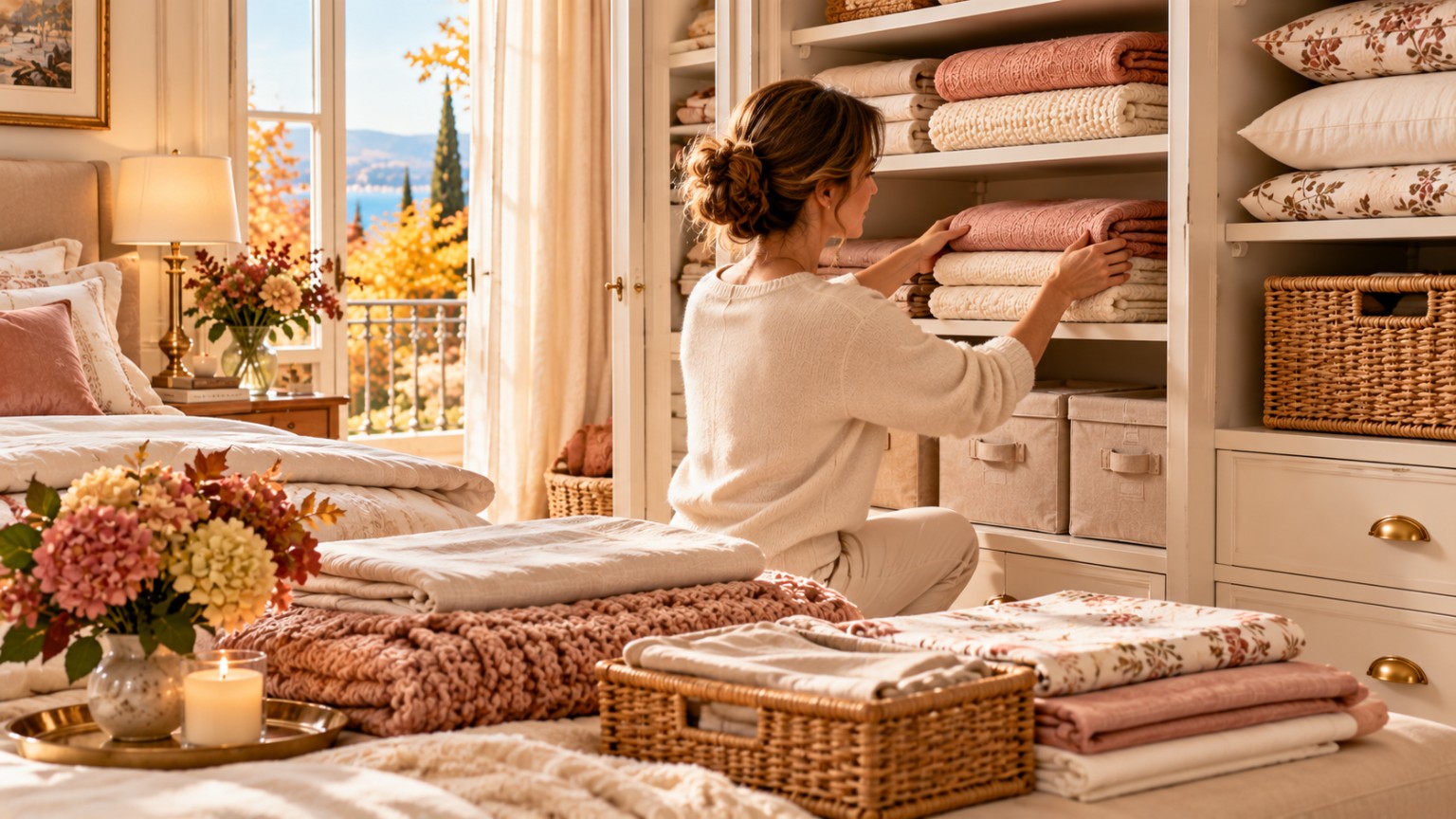
Before putting your summer textiles away, set aside a few minutes.
Are the light coverlets, summer duvet cover sets, lightweight bedspreads and guest sheets truly clean? Is there anything yellowed, stained or in need of mending? A fitted sheet whose elastic has gone slack, a towel with an unravelled hem, a pillowcase waiting for a small repair?
Putting seasonal textiles away with a promise to "deal with it later" simply carries the problem into the next season.
So going over every piece that returns to the cupboard is a good place to start.
Then a simple sorting can be made:
I use it.
I'll mend it.
I'll donate it.
I'll store it for the season.
I'll keep it as a keepsake.
Sometimes order calls not for a new cupboard, but simply for a few right decisions.
HOW MANY SETS OF BED LINEN DOES A HOME NEED?

One of the reasons linen cupboards become overcrowded is that we no longer know how much of the linen accumulated over the years we actually need.
There is no single number that suits everyone. The size of the family, how often the laundry is done, how often guests come to stay and the number of beds in the house all change what is needed.
Still, a simple measure can serve as a starting point:
2–3 duvet cover sets for each bed.
One in use, one in the wash and, if needed, one spare.
2–3 bath towels per person.
1–2 clean sets for the guest bed.
These are not rules, but a starting measure you can use when assessing your cupboard.
In a small home where laundry is done several times a week, for example, fewer textiles may be enough. In a home that often welcomes guests, on the other hand, a few extra sets are entirely practical.
The real question is this:
Not "How many do I have?" but "How many do I actually use?"
If you have been saving your most beautiful bed linen for years "for when guests come", yet when guests do come you still reach for one of your everyday sets, perhaps that beautiful bed linen's time came long ago.
WHERE SHOULD EACH TEXTILE BE KEPT?
In a well-ordered linen cupboard, it is not only the way things are folded that matters, but the order in which you reach them.
Bed linen, towels and bed throws that will be used often through autumn and winter can be kept on easy-to-reach shelves.
Guest textiles used less often can be gathered in a separate section.
Summer coverlets and light throws, once cleaned and thoroughly dried, can be moved to higher or less-used shelves.
To keep the pieces of a duvet cover set from becoming separated, a practical method is to store the whole set inside one of its own pillowcases. That way, when you open the cupboard, there is no need to hunt for the sheet on one shelf and the pillowcase on another.
When it comes to larger pieces, however, the storage method should change according to the fabric.
NOT EVERYTHING BELONGS IN A VACUUM BAG
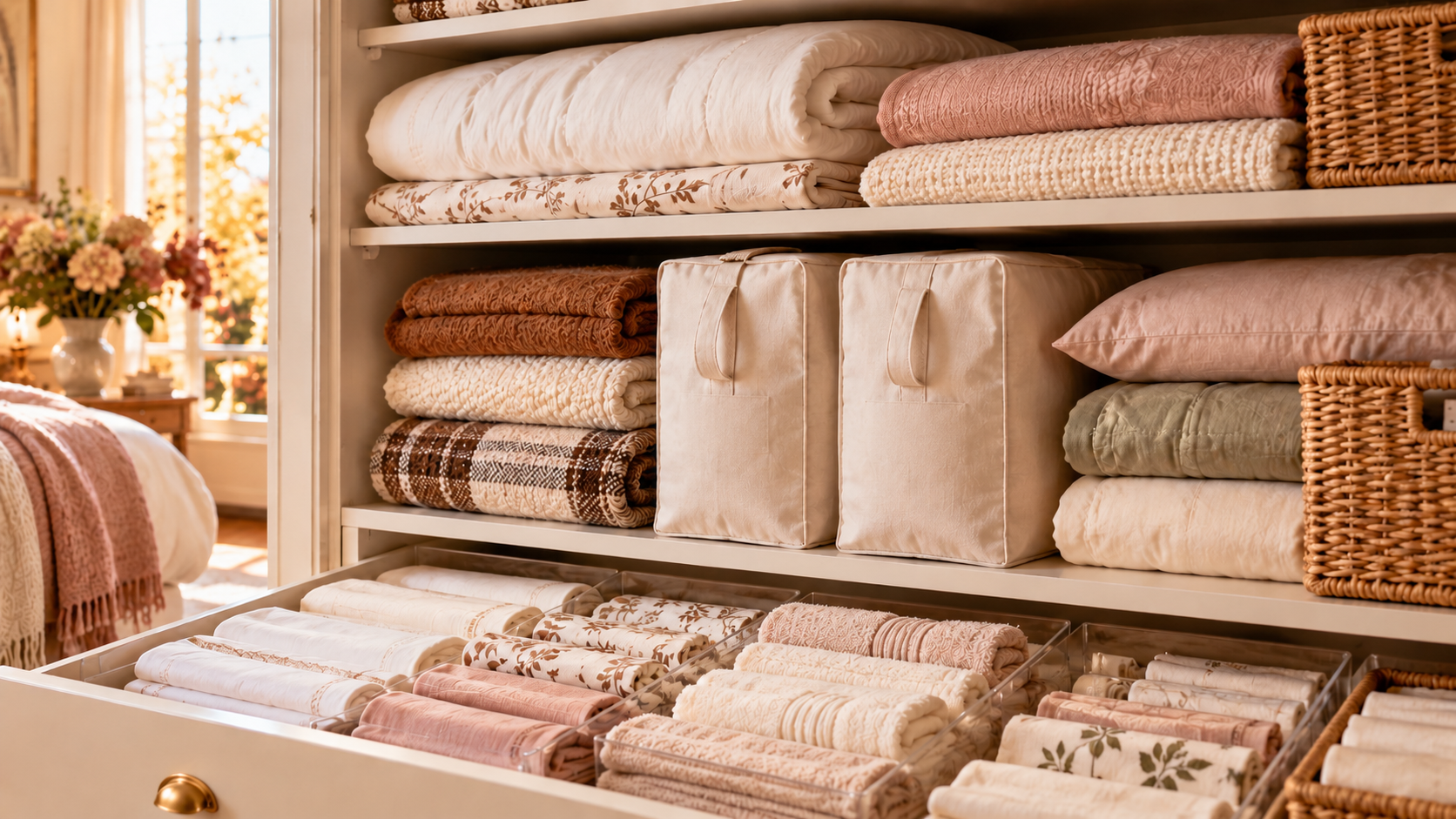
Vacuum bags can save a great deal of space, especially in small homes. But they are not the right choice for every textile.
While they can be practical for short- or medium-term use with some bulky items with synthetic filling, compressing goose-down duvets and wool blankets tightly for long periods can harm the structure of the filling and fibres.
For precious natural materials like these, breathable cotton storage bags are a gentler option.
The point here is not to draw a simple line such as "plastic is bad, natural is good".
The storage material should suit not only the item being stored, but also the place where it is kept.
In a dry but dusty storeroom, a well-sealed box can be useful. In a damp space, however, putting damp textiles inside an airtight box can trap the moisture inside.
So whatever you use, the first rule never changes:
Textiles that are put away must be completely dry.
For long-term textile storage, ordinary cardboard boxes are best avoided where possible. Cardboard can be affected by damp, and over long periods it does not offer ideal protection for textiles.
NOT AVOIDING PLASTIC, BUT CHOOSING THE RIGHT MATERIAL
In recent years, more natural textures have come to the fore in home organisation: woven baskets, wooden dividers, cotton and linen bags, glass jars…
The reason is not only aesthetic.
Natural materials can reduce the visual clutter created by plastic organisers, especially on open shelves and in living spaces such as the bedroom. Wood, linen, cotton and wicker give a home a warmer, more timeless look.
But the measure of Zarif Order remains the same:
Let it come into the home not because it is beautiful, but because it is useful.
Buying ten new baskets and trying to fill them is not order.
First, let us decide what we need to store; then, if necessary, choose the storage that suits it.
Sometimes the most sustainable organiser is the box we already have at home that still does its job well.
THE PLACE OF LAVENDER AND CEDARWOOD IN THE CUPBOARD
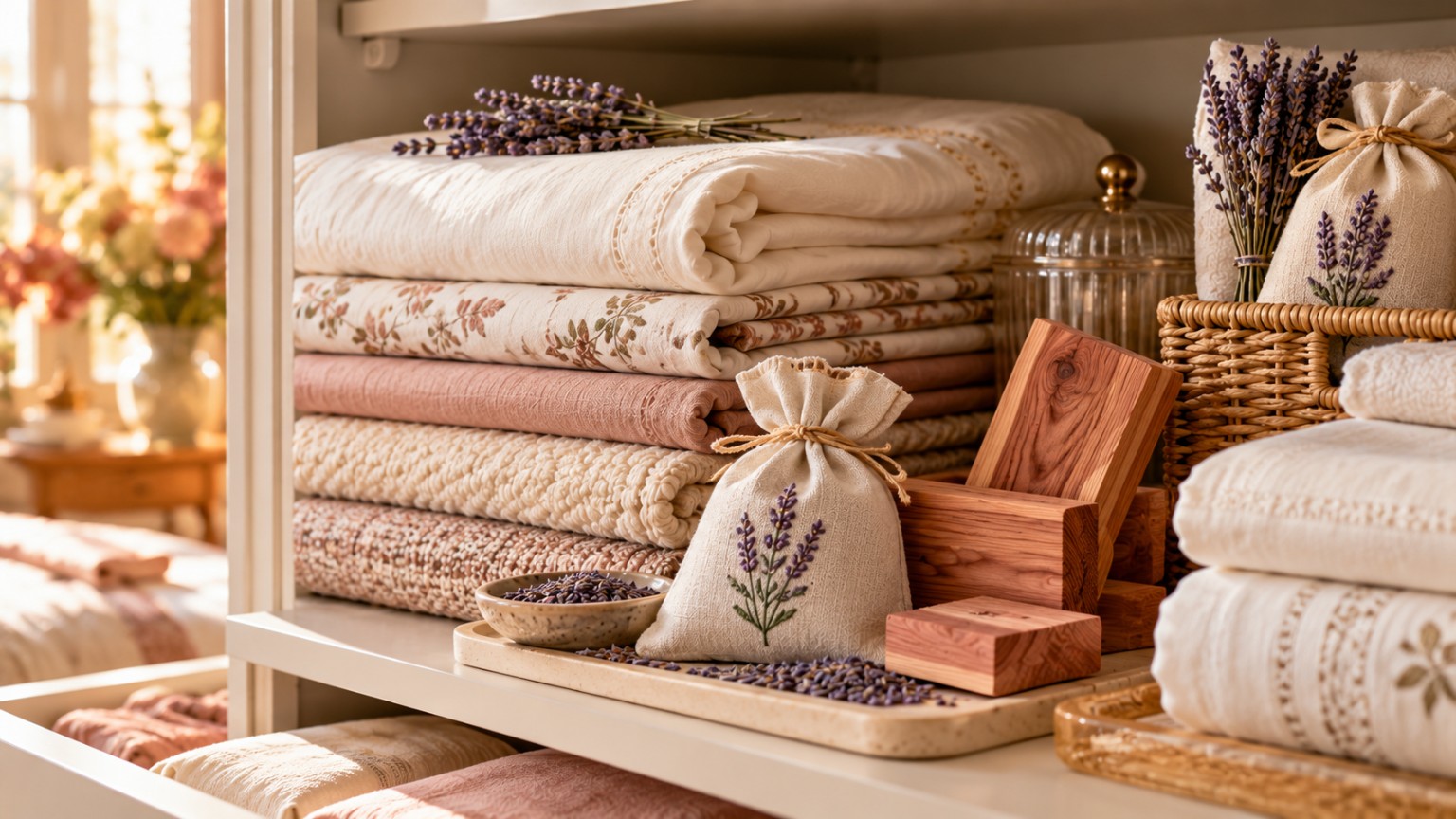
A small lavender sachet tucked among clean textiles can leave a pleasant, calming scent when you open the linen cupboard.
Pieces of cedarwood are also one of the traditional choices, particularly where woollen textiles are stored.
Lavender and cedarwood can help deter moths; on their own, however, they do not offer guaranteed protection. When the scent of cedarwood fades over time, its aroma can be revived by very lightly sanding the surface.
Rather than spraying perfume or strong essential oils directly onto textiles to boost the scent, it is better to keep scented pieces separate from the fabric.
Because with a textile that stays shut away for months, the aim is not to leave a heavy scent, but to find it again clean and well preserved.
THE TROUSSEAU WAITING IN THE HOPE CHEST
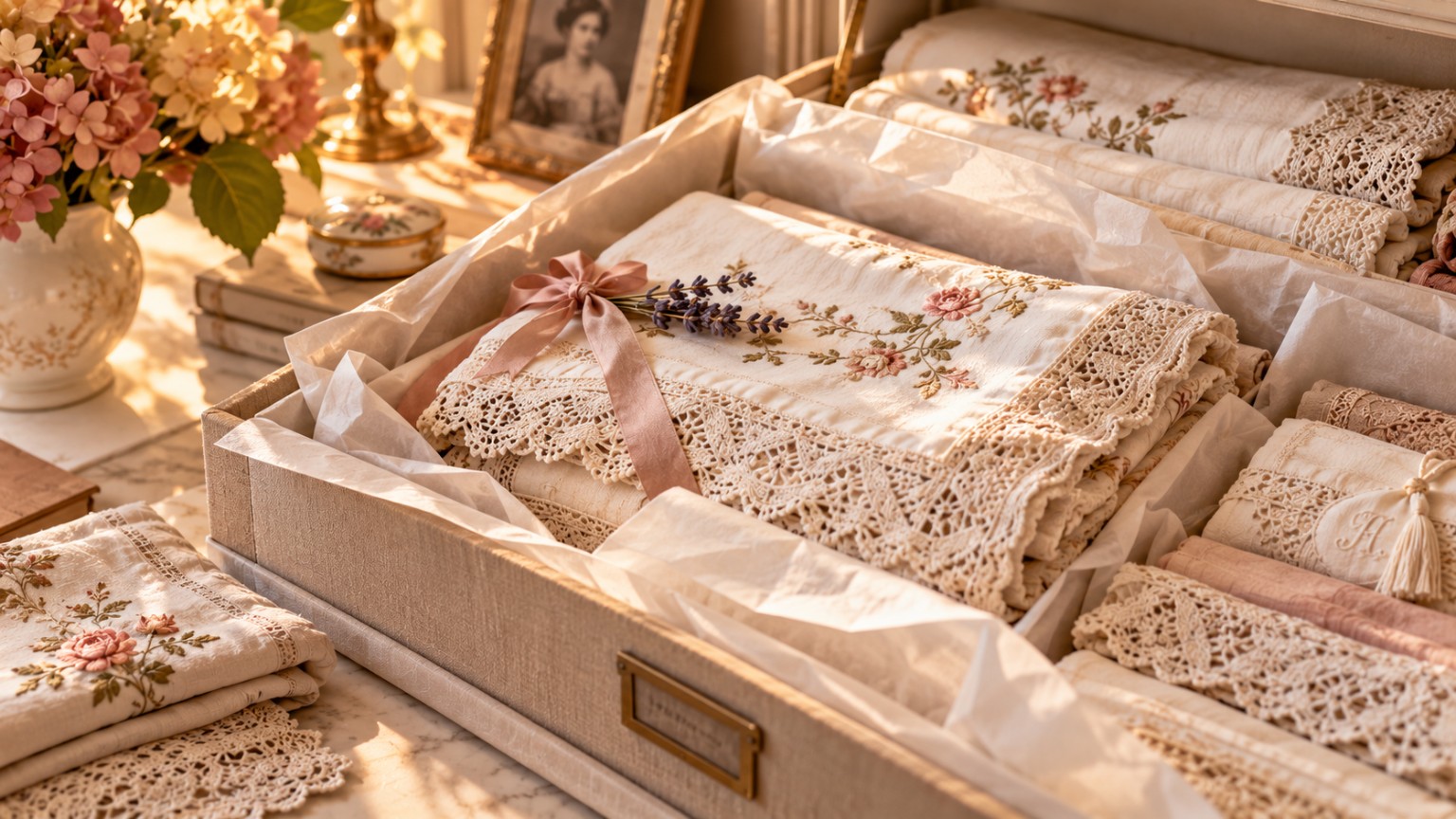
In some homes, the most beautiful pieces in the linen cupboard are the least used.
Embroidery passed down from grandmothers, handmade lace, pillowcases from a trousseau, tablecloths prepared with great care many years ago…
We don't use them because we can't bear to.
And because we don't use them, we leave them waiting in the same place for years.
Yet old and delicate textiles need a particular kind of care to be preserved. Precious embroidered or lace pieces should be stored clean, with suitable protective materials, and should not be left for long on the same sharp fold lines. Acid-free tissue paper can be used for delicate pieces.
It is also important not to store these pieces for long periods in plastic bags or in places that get direct sunlight.
Taking them out once a year to air them, and changing where the folds fall when you fold them again, helps reduce the wear that can form along the same line over the years.
But there is another question here.
If we save all our beautiful things for the future, what will we use today?
Of course, we need not bring a very precious family heirloom into everyday use.
But if there is a beautiful tablecloth in our cupboard that has been waiting years for "a special day", perhaps an ordinary Sunday breakfast is that special day.
The loveliest thing about a trousseau is not only that it is passed down from generation to generation; it is that it becomes part of a home's life.
20-MINUTE ZARİF ORDER
When we think of tidying, we may picture great operations lasting hours, with every cupboard emptied and the bed covered in things.
Yet not every day of tidying has to be like that.
This October, try another approach:
Just 20 minutes.
Just one area.
Today, only the towels.
Tomorrow, only the pillowcases.
Another day, the guest bed linen.
Then the blankets.
When the 20 minutes are up, stop.
But finish the small area you started.
This approach turns order from a large, tiring task into a small ritual of care within daily life.
Because for order to be sustainable, it doesn't need to be perfect.
It needs to be repeatable.
ZARİF ORDER CHECKLIST
When you open your linen cupboard this October, ask yourself these questions:
□ Are the summer bed linen and throws clean and ready to be put away?
□ Are the autumn–winter textiles ready to use?
□ Have worn pieces, or those in need of mending, been set aside?
□ Are we keeping more bed linen or towels than we truly need?
□ Are the guest textiles kept separately and easy to find?
□ Are the duvets and blankets stored in a way that suits their materials?
□ Have the trousseau and keepsake textiles that have been waiting a long time been checked?
□ Have the folds on delicate pieces been changed?
□ Does the cupboard hold only the pieces we truly use, or those we consciously keep because they mean something to us?
There is no need to do them all on the same day.
Choosing one is enough.