Zarif Garden & Home
AUTUMN BEYOND THE GLASS
Elegance That Reaches from the Home into the Garden
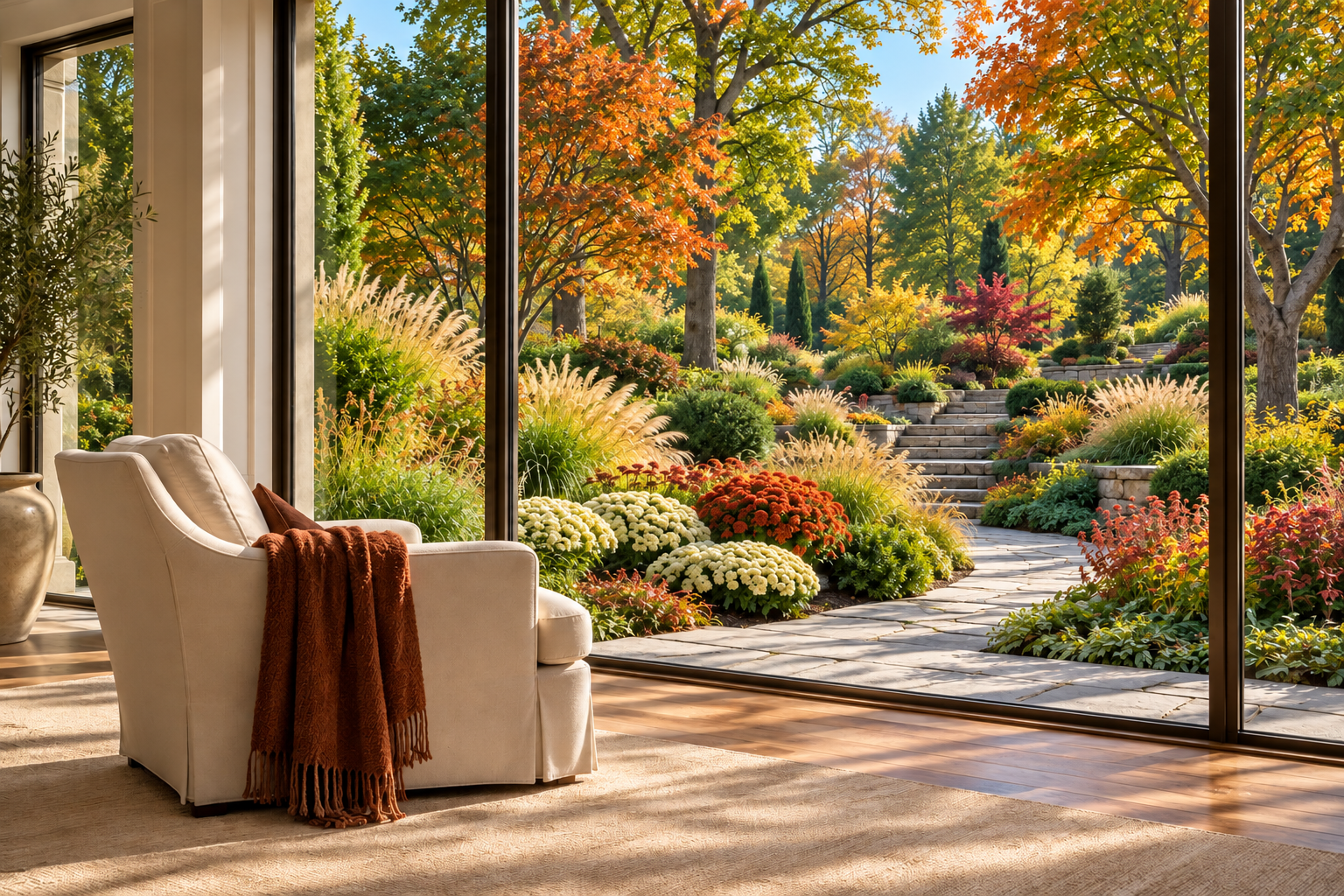
Autumn begins at the window before it ever reaches the garden. One morning you draw back the curtain and see that the trees have turned orange, copper and burgundy. That is the moment when home and garden begin to tell the same story.
In the summer months, the garden is lived outside the house. In autumn, the relationship reverses: we now mostly admire the garden from indoors, from behind the glass. So in October, making the garden beautiful really means making the view from the window beautiful.
October is not the greyness of November. The sun is still warm and the colours are at their most vivid. This month, we create a single whole that runs from the windowsill to the terrace and from there to the furthest corner of the garden, and we make the soil the first promises of spring. Whether you have a large garden or a single windowsill, the principle is the same: the eye should be able to travel from inside to out in one uninterrupted line of elegance.
AN AUTUMN CORNER BY THE WINDOW
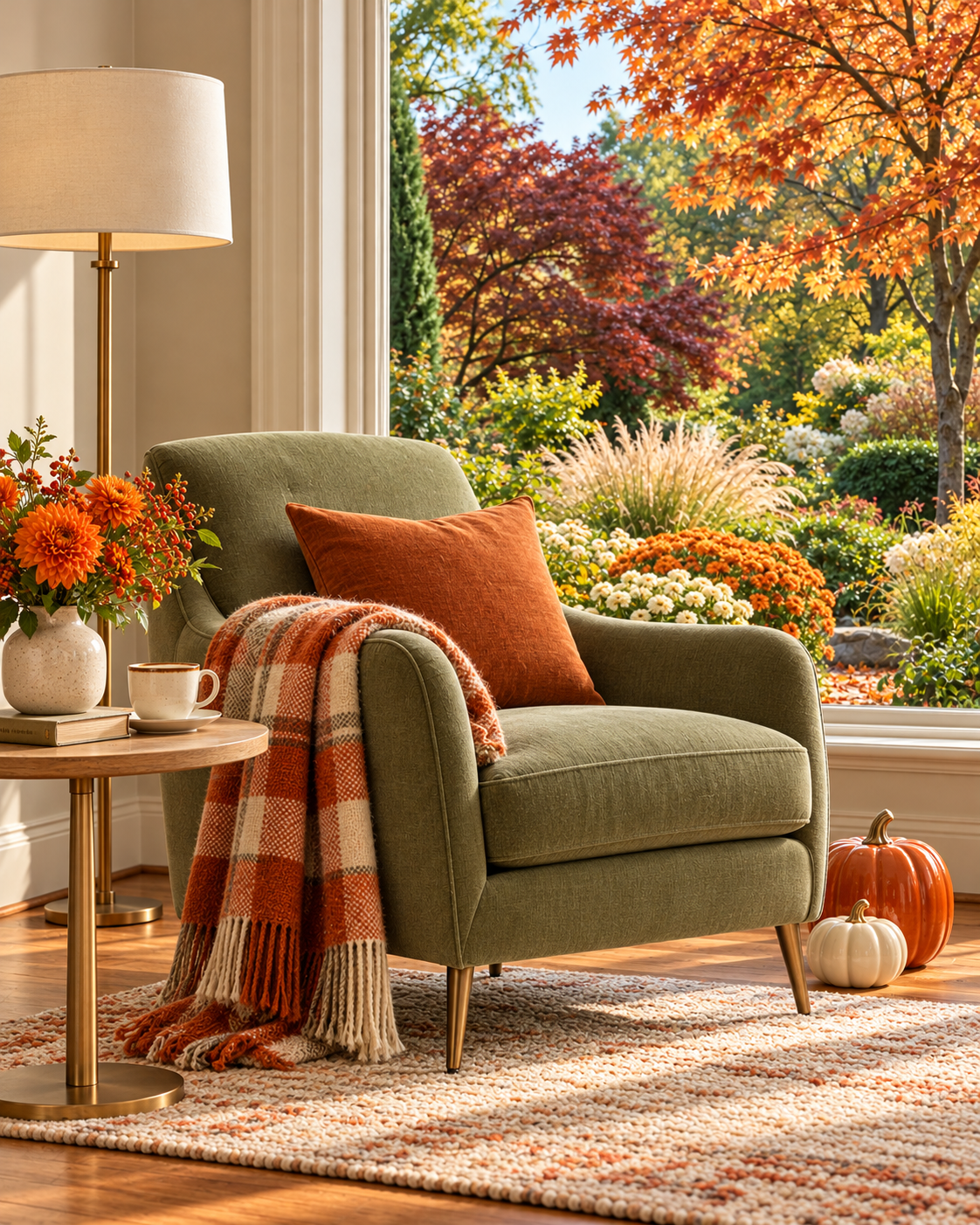
The loveliest corner of autumn is a window that looks onto the garden. You don't need much to create it; what you need is the right arrangement.
Set the armchair at a slight angle. A chair facing squarely towards the glass cuts the corner off from the room; one set at a slight angle shows you the garden while keeping your connection to the room. This is what unites the two worlds.
A small side table is enough. On it, a cup, a book and a single vase. The table should be at the seat height of the chair or a little lower; you should be able to reach it easily when you stretch out your hand.
Take your colours from the garden. Echo the colours outside in the cushions and the throw: burnt orange, copper, chestnut. Don't fold the throw too carefully; leave it over the arm of the chair as though it had just been used. And put a few orange dahlias or a sprig of rose hips from the garden in the vase. Let inside and out speak of the same season.
Don't block the view. Every object placed in front of the window becomes part of the frame between you and the garden. A single, low plant on the sill is enough; tall plants interrupt the view. During the day, keep the curtains fully open so that the garden comes inside like one of the room's walls.
A NEW MOOD FOR TERRACE AND BALCONY
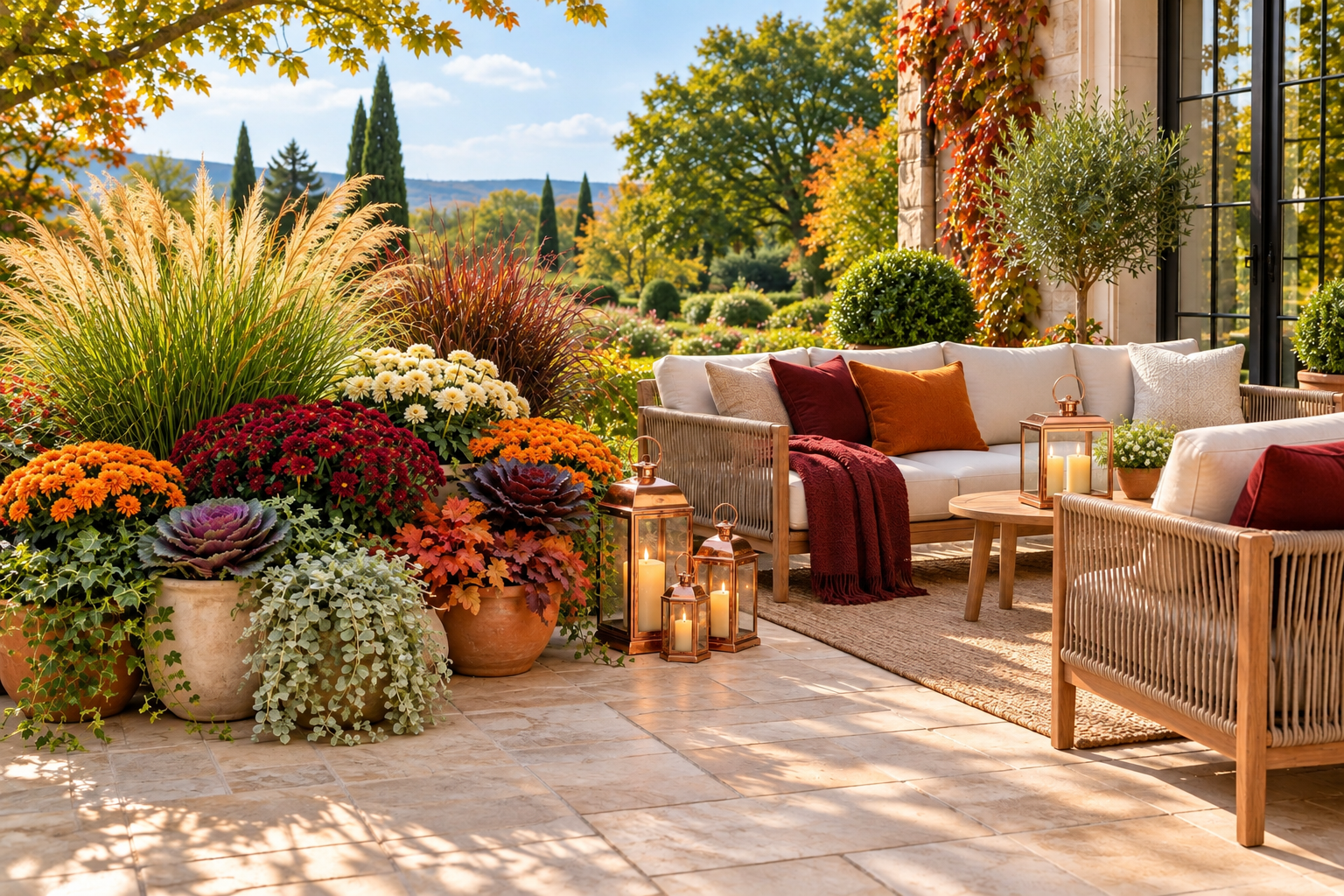
The terrace is the bridge between house and garden. In autumn, we build this bridge with colour. Keep the base calm: cream and natural wood. Let the accent colours bring the life: orange, copper and burgundy. This warm family speaks the same language as "The New Colour Codes of Autumn" in this issue's Fashion & Style section; the colours we wear and the spaces we live in tell the story of the same season.
Cushions: Put away the white and pale blue cushions of summer. Two or three orange, copper or burgundy cushions on a cream base are enough. The rule is simple: one base colour, one accent family. Don't use every colour on the same seat.
Lanterns: Copper or aged-metal lanterns are the most elegant accessory of autumn. Three lanterns of different heights are more striking than five scattered one by one. Group them.
Pots and the Three-Height Rule: What makes a group of pots elegant is that the plants stand at different heights.
- Tall: Ornamental grasses that bring movement and lightness (feather grass, carex)
- Medium: Plants that carry the colour (chrysanthemums, ornamental cabbage, heuchera)
- Trailing: Plants that soften the edge of the pot (ivy, dichondra)
Choose natural materials for your pots: terracotta, stone or matt ceramic. Use no more than two pot materials in the same group.
AUTUMN COMPOSITIONS IN THE GARDEN
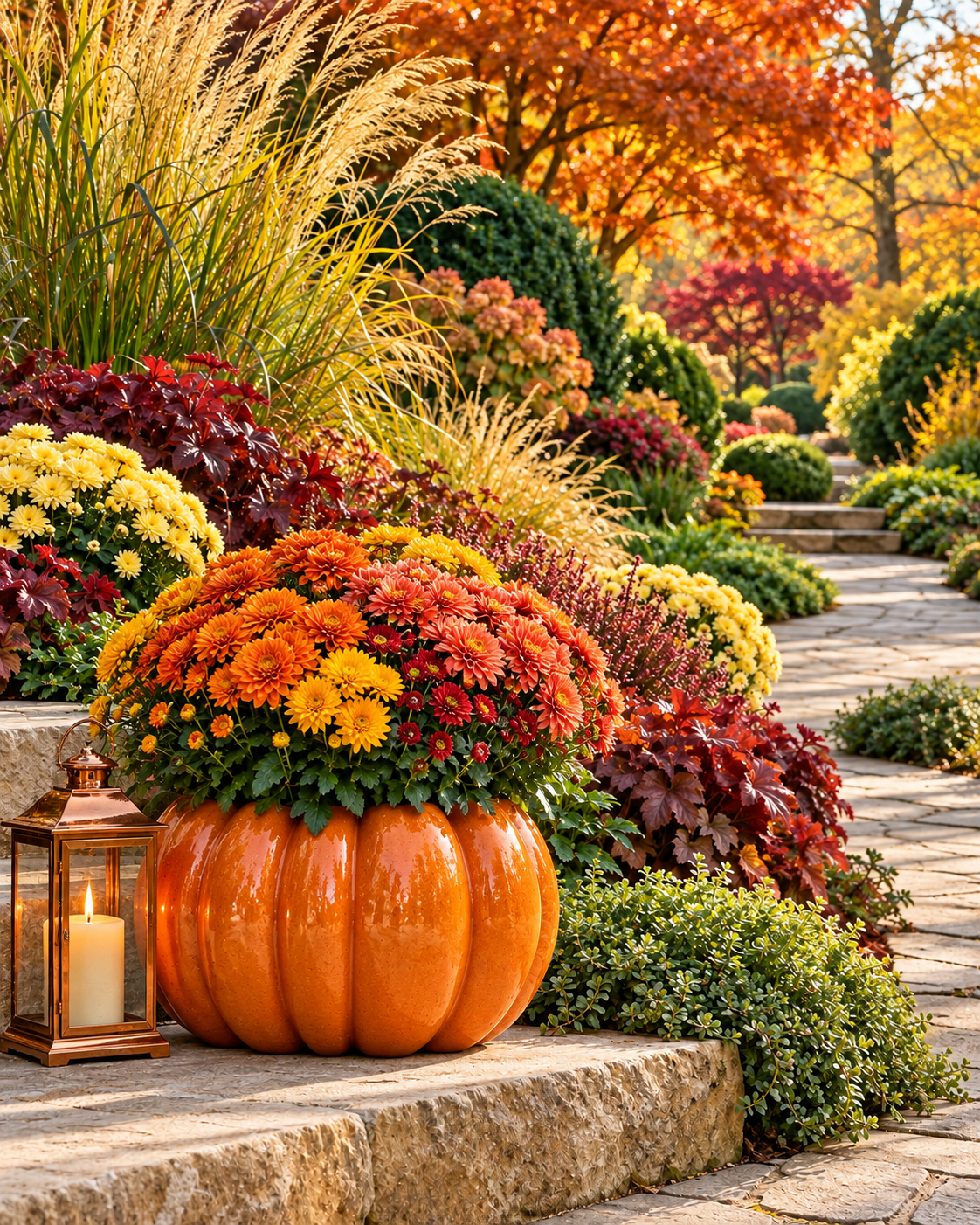
An autumn garden asks not for abundance, as a summer garden does, but for a curated beauty. Yet curated does not mean faded. An October garden deserves to be vibrant.
Flowers of the season: The chrysanthemum is the queen of autumn. Combine orange, copper, burgundy and cream tones; orange brings energy, while cream brings calm. The burgundy leaves of heuchera create depth among the flowers. Erica (heather) forms a low, soft carpet, cyclamen brightens shady corners, and ornamental cabbage adds a sculptural texture that lasts into winter.
Different heights, the same principle: The three-height rule for terrace pots applies in the garden, too. Tall ornamental grasses and shrubs at the back, flowers in the middle, low ground cover at the front. When you look at the garden from the window, these layers create a sense of depth.
Pumpkins, a measured touch: This is exactly where the line between elegance and clutter lies. Don't put pumpkins everywhere; place them at a single point: on a step, beside a bench or at the foot of a group of pots. One strong focal point is enough: a large pumpkin, a pumpkin-shaped planter or at most three in different sizes. Fill the planter with the season's orange chrysanthemums and set a copper lantern beside it; leave the rest to the garden.
WHAT ARE WE PLANTING IN OCTOBER?
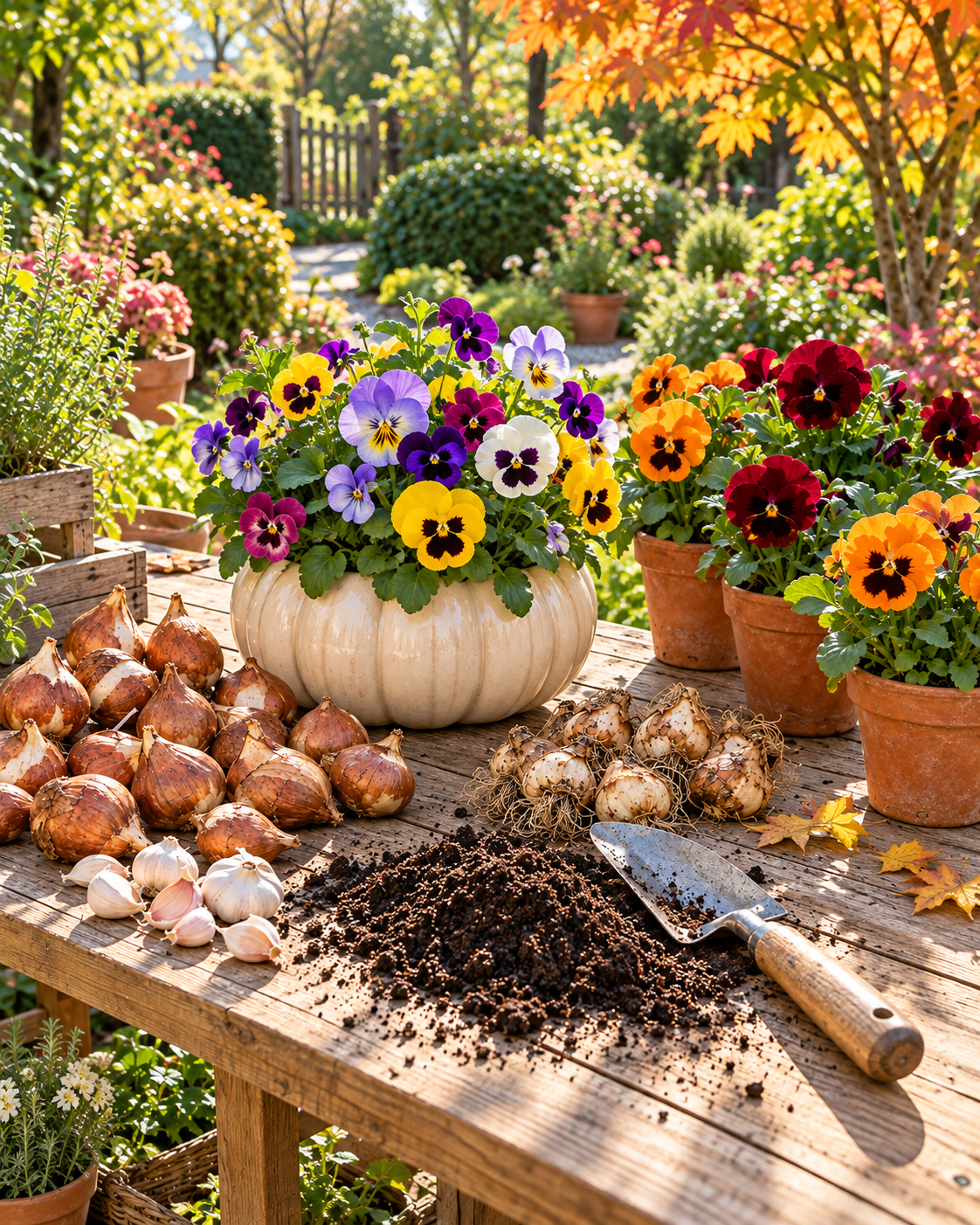
October is one of the most fruitful planting months of the gardening year. The soil still holds the warmth of summer, the rains begin, and roots have time to settle in before winter arrives. Everything you give the soil this month comes back to you in spring.
Bulbs for Spring
Tulips, hyacinths, daffodils, muscari, snowdrops and anemones. October is the month of spring bulbs.
- Depth: Plant at a depth of 2–3 times the bulb's own height.
- Direction: Set them with the pointed tip facing upwards.
- Grouping: Plant in groups of 5–7 rather than one by one. In spring they will look more natural and fuller.
- Timing: Hyacinths, daffodils, muscari and snowdrops can be planted from the beginning of October. Tulips are best planted once the soil has cooled a little, between late October and November.
- Anemones: Soak the tubers in lukewarm water for a few hours before planting.
A layered pot for the balcony: In a deep pot, plant tulips at the bottom, daffodils in the middle and muscari on top. From a single pot, you will have flowers in succession from March to May.
Flowers That Bloom All Winter
- Pansies: The star of October. Pansies planted now keep flowering through the winter and into spring. Their orange, burgundy and cream tones suit this month's palette beautifully.
- Wallflowers and snapdragons: Planted now, they become the first fragrant, colourful flowers of spring.
- Chrysanthemums and ornamental cabbage: Buy them as plants already in flower; they bring instant colour to the garden.
- Cyclamen: For half-shaded corners and windowsills.
The October Kitchen Garden
The vegetable garden does not stand empty in autumn.
- Garlic: Plant the cloves 4–5 cm deep with the pointed tip facing upwards. You will harvest them in June.
- Onion sets, broad beans and peas: They spend the winter in the ground and give the first harvest in spring.
- Spinach, lettuce, rocket, cress and parsley: They love cool weather and provide fresh greens all winter.
A kitchen garden on the balcony: Rocket, cress and parsley in one deep pot; a few cloves of garlic in a separate pot. From a small space, fresh greens come to the table all winter long.
Saplings, Shrubs and Lawn
The planting season for roses, fruit trees and deciduous ornamental trees begins from late October. Ornamental grasses and heuchera also go into the ground this month. Autumn is the best time of year to fill in thin patches of lawn or to sow new grass; the soil is warm, the air is cool and the seed does not have to battle the scorching heat of summer.
A note on climate: In colder inland regions, finish your planting in the first half of October. In mild coastal regions, you can spread your planting through to the end of November.
THE LIGHT OF THE EVENING GARDEN
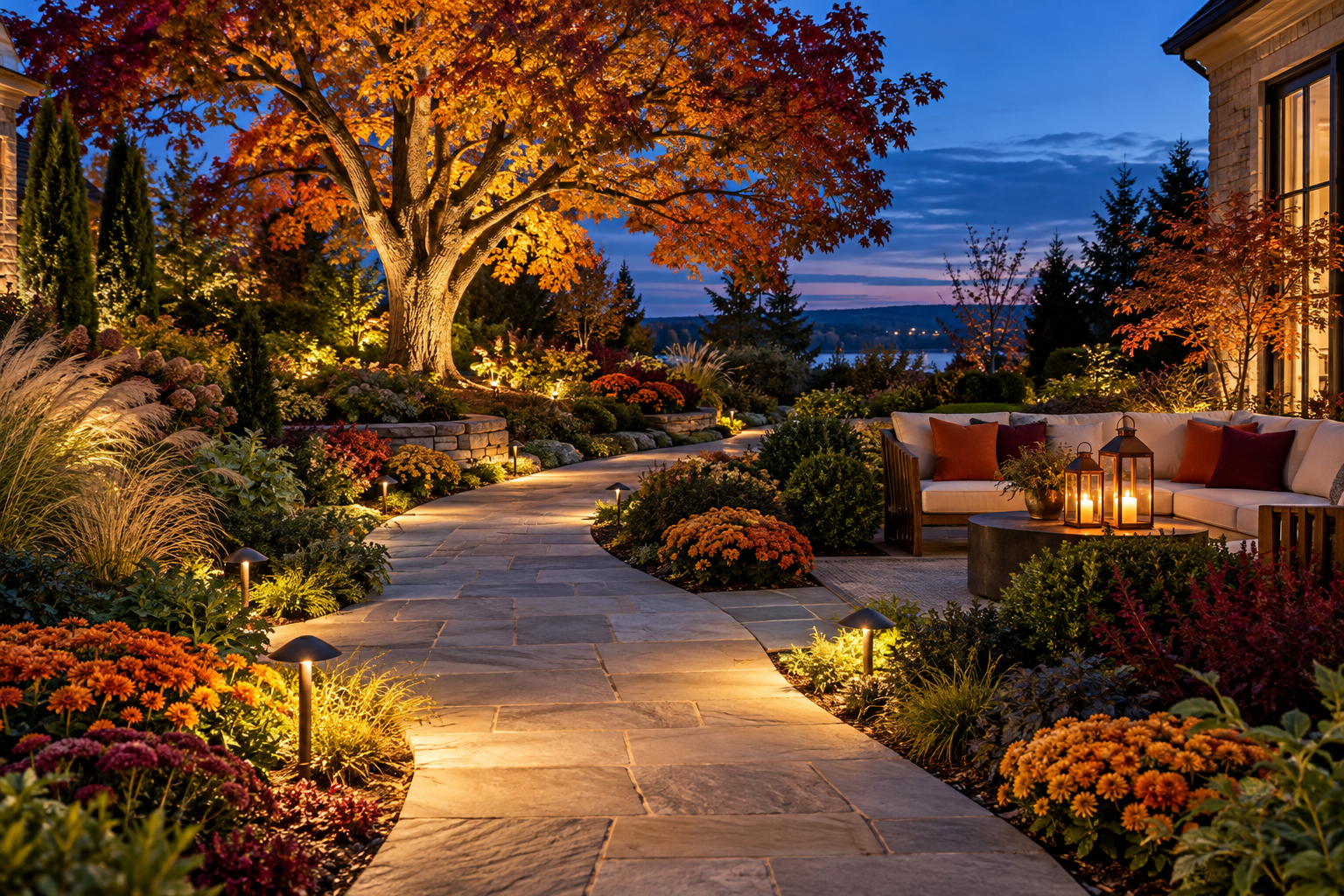
In October, evening falls early. The hours when we see the garden most are now the hours when the light is fading. This is why evening light is half of the autumn garden.
Choose warm white. For outdoor bulbs, opt for warm white light of around 2700K. Cool white light turns a garden into a car park; warm light makes the orange and copper tones of the leaves glow.
Keep the light below eye level. Elegant garden lighting does not dazzle; it simply reveals. Instead of high wall lights, use low, downward-facing lights close to the ground.
Three kinds of light, three different roles:
- Paths: Light the walkway from the side and from low down. Let the light show the step, not the path.
- Seating area: Lanterns and candles. Here the light should be soft and diffused.
- Plants: Light a tree or a cluster of ornamental grasses from below. Seen from the window in the evening, the garden's shadows look like a painting.
For those who don't want to install wiring, solar lanterns and stake lights are a good place to start.
THE SAME ELEGANCE IN SMALL SPACES
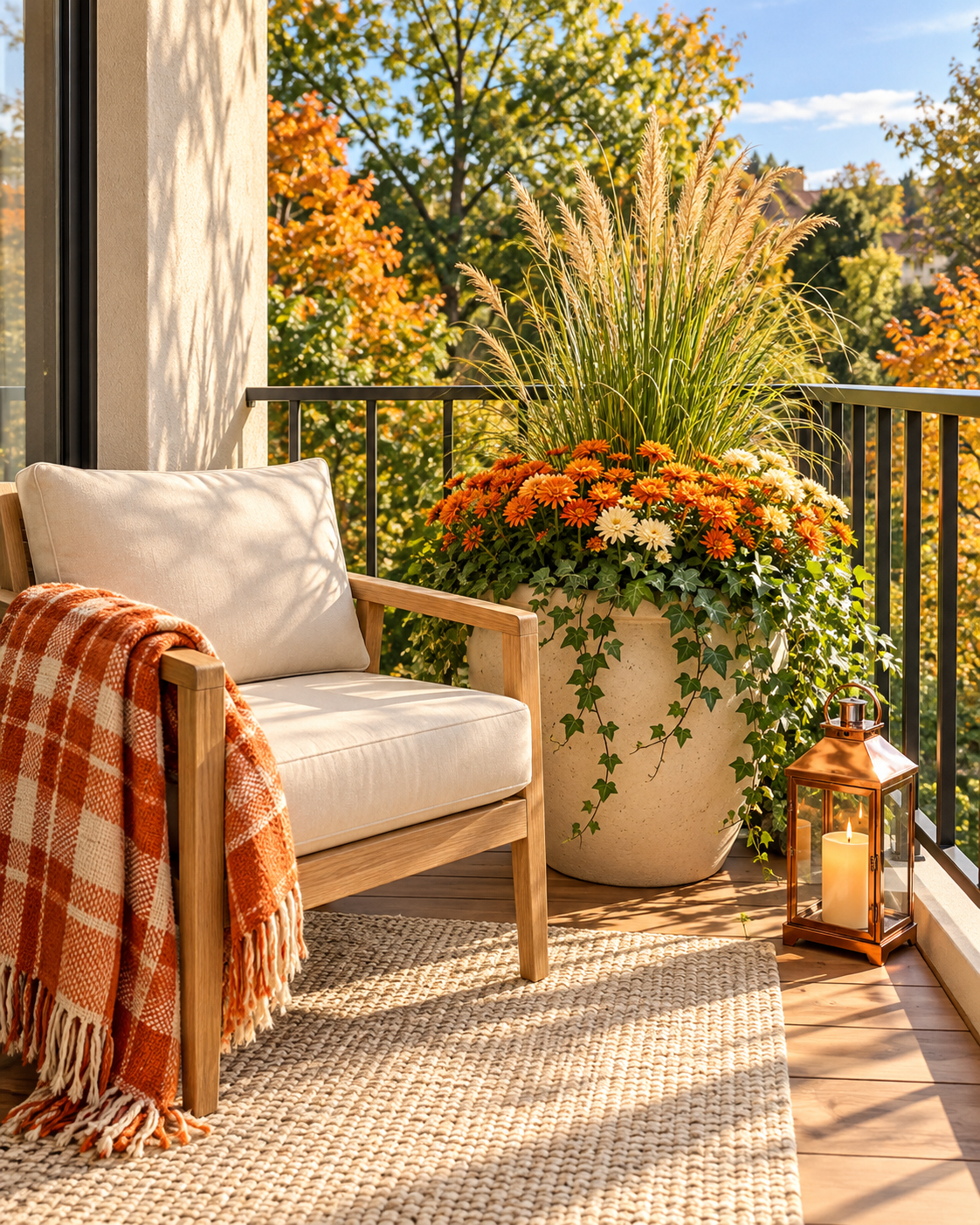
Elegance is not measured in square metres. If you don't have a large garden, you can create the same feeling on a balcony or by a window. Our formula is this:
One pot, one lantern, one throw.
- One pot: Apply the three-height rule in a single pot. An ornamental grass in the centre, two orange chrysanthemums or pansies around it, a trailing ivy at the edges.
- One lantern: Copper or metal, with an LED candle inside.
- One throw: Over the arm of a balcony chair or the armchair by the window.
On a small balcony, laying an outdoor rug on the floor makes the space feel like an extension of the room. And planting pansies and cyclamen in a window box gives a home without a garden a garden seen from its window.