ZARİF FORMULAS — OCTOBER 2026
MAKE YOUR OWN SHAMPOO, CONDITIONER AND FACE CREAM
AT HOME, SMALL AND FRESH
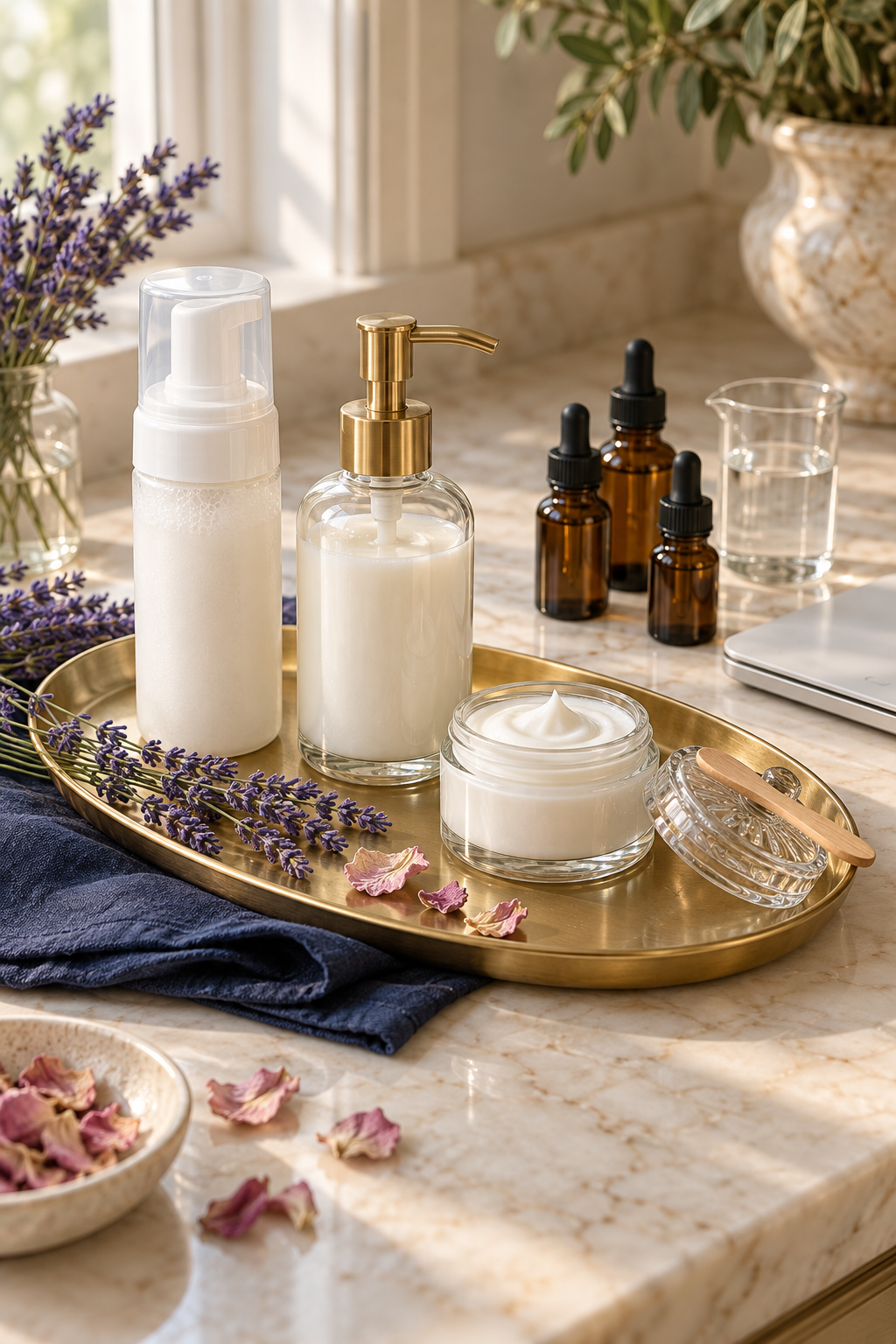
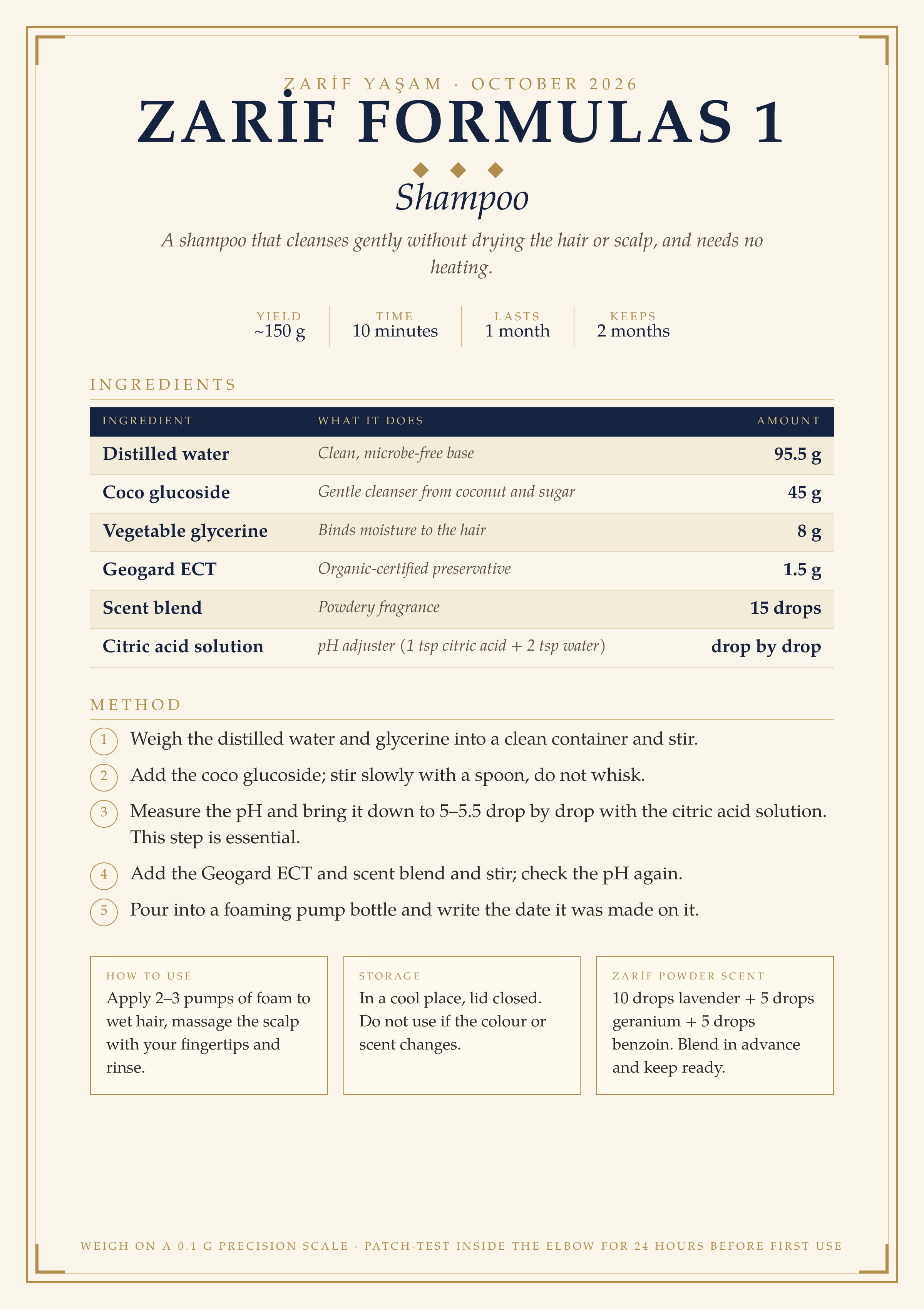
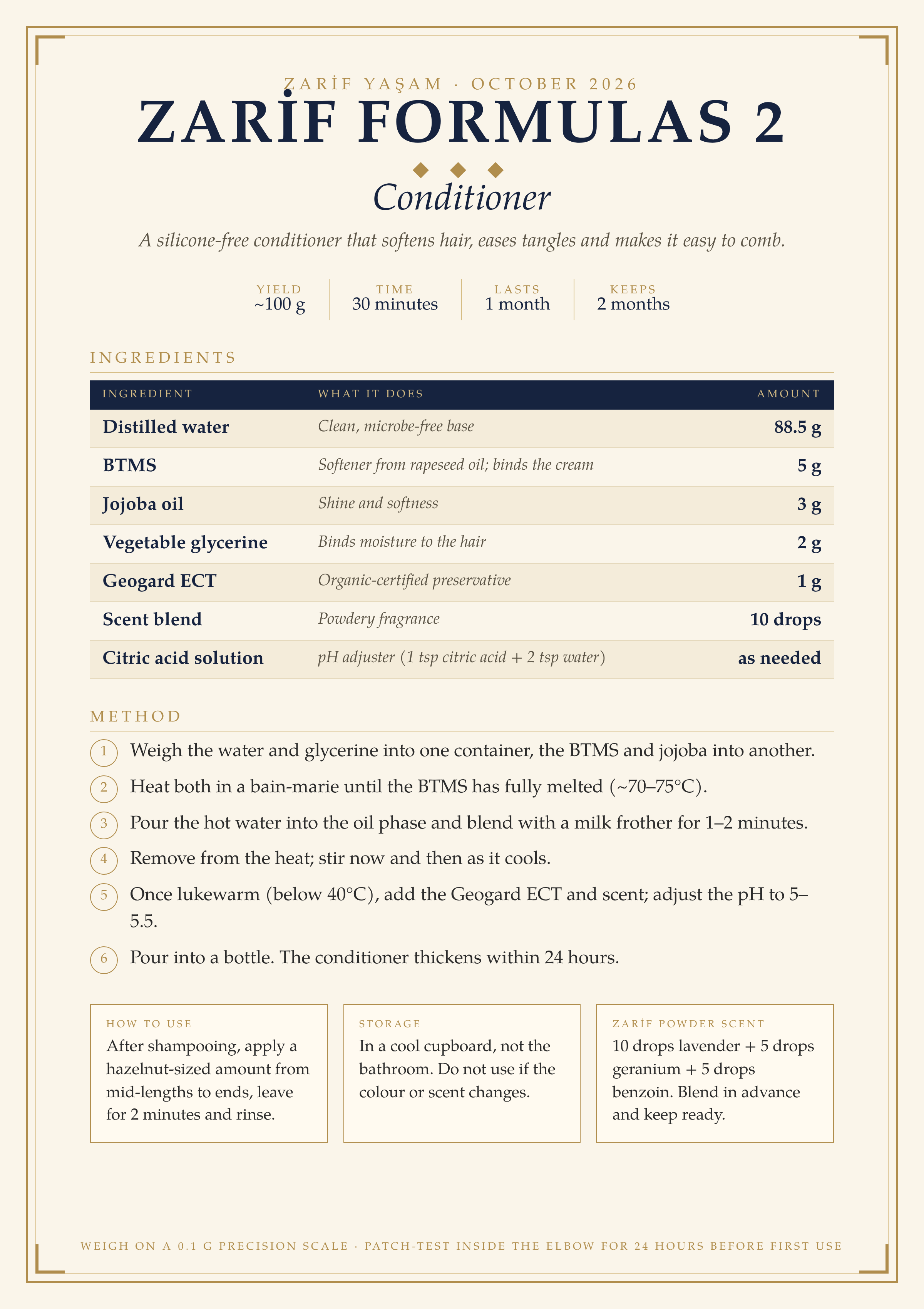
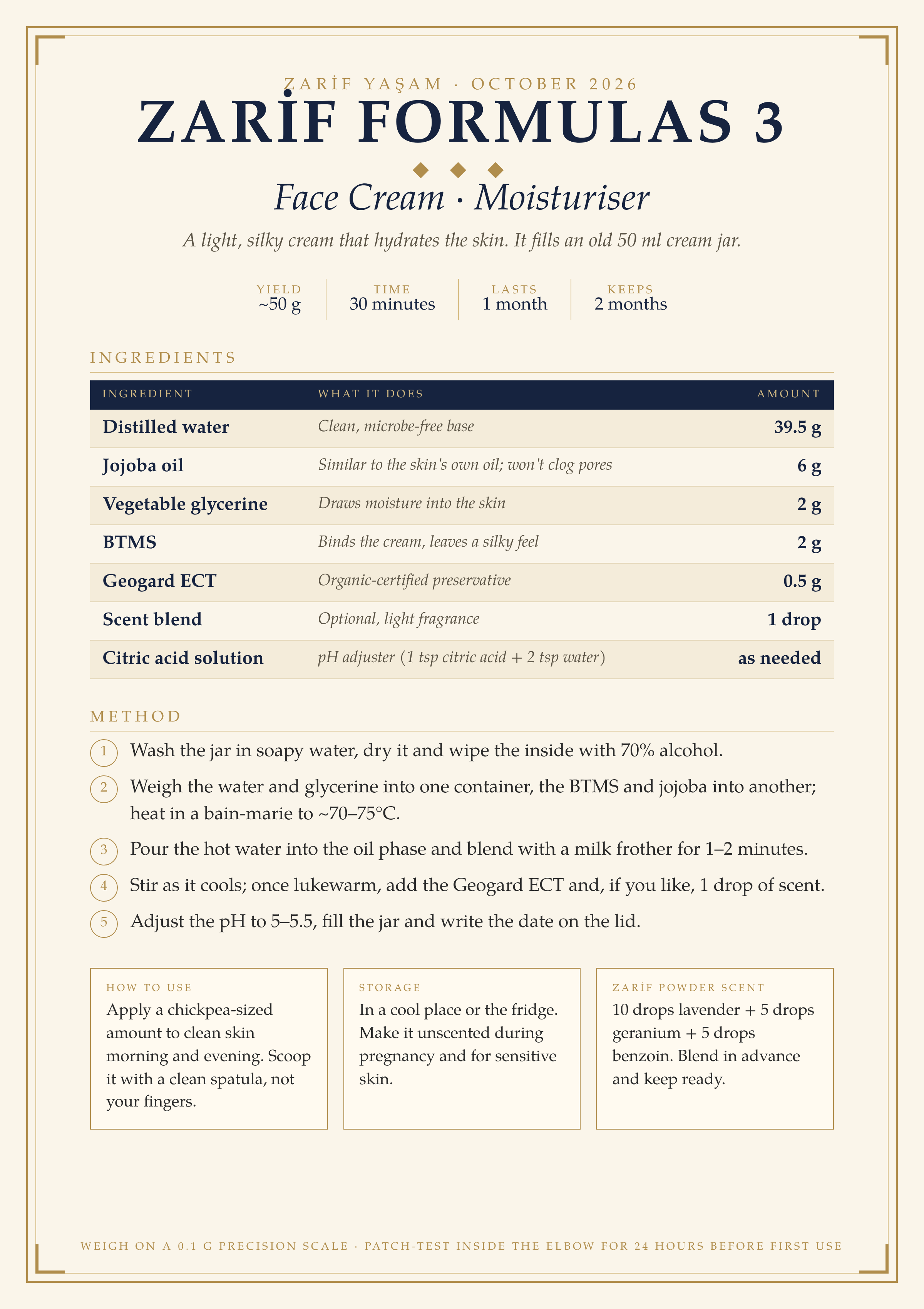
This month we are making three care products on the kitchen counter: a shampoo that gently cleanses the hair, a conditioner that softens it and makes combing easier, and a face cream that moisturises the skin. All three can be made at home with just a few ingredients.
The secret lies in small batches. Each recipe is calculated for roughly a month’s use; the face cream is just enough to fit an old cream jar. Making a little and using it fresh keeps the product cleaner, and gives you the pleasure of making it anew each month.
We use the same seven ingredients in every recipe. Buy them once, and they work across all three products. To each, we add a soft, powdery scent.
WHAT YOU WON’T FIND IN THESE RECIPES
To keep the essence within the little, we left the following out of every recipe:
- SLS, SLES, ALS, ALES: Harsh, foaming cleansers
- Parabens and formaldehyde releasers: Controversial preservatives
- MEA, DEA, TEA: Texture and pH adjusters
- Phthalates and triclosan
- BHT, BHA: Synthetic antioxidants
- Silicones: Substances that coat the hair and weigh it down over time
GETTING TO KNOW THE INGREDIENTS
Seven ingredients, three products. We have given the international name (INCI) printed on the back of the packaging in brackets; check for this name when you buy.
1. Distilled water (Aqua)
Water purified of minerals and microbes. The minerals and microbes in tap water spoil a cream, so tap water cannot be used in its place. Buy pharmacy distilled water, not battery water.
2. Vegetable glycerine (Glycerin)
It draws moisture from the air and binds it to the skin and hair. It is an odourless, clear, slightly sticky liquid. Choose one of plant origin.
3. Jojoba oil (Simmondsia Chinensis Seed Oil)
Strictly speaking a liquid plant wax, it closely resembles the skin’s own oil. It does not clog pores and rarely irritates. This is the oil that nourishes in the face cream and adds shine in the conditioner. Choose cold-pressed and organic.
4. Coco-glucoside (Coco-Glucoside)
The cleanser in the shampoo. It is made from coconut oil and sugar. It cleanses without drying the scalp and is also used in baby products. It doesn’t lather as generously as commercial shampoos; that is the price of its gentleness. Decyl glucoside (Decyl Glucoside) works in its place too.
5. BTMS (Behentrimonium Methosulfate, Cetearyl Alcohol)
A conditioning agent derived from rapeseed oil, sold as small white pellets. It does two jobs at once: it softens the hair and eases tangles, and it binds water and oil together to create a creamy texture. It is not a silicone. On the skin it leaves a silky, powdery feel. The packaging usually reads "BTMS-25" or "BTMS-50"; either will do.
6. Geogard ECT (Benzyl Alcohol, Salicylic Acid, Glycerin, Sorbic Acid)
The preservative. Any product containing water starts to grow bacteria and mould within a few days without a preservative; most of the time this cannot be seen with the naked eye. Geogard ECT is a preservative accepted under organic cosmetics certifications (Ecocert, COSMOS). It is added at 1 per cent and only works fully below pH 5.5. Because it contains salicylic acid, anyone allergic to aspirin should not use it.
7. Citric acid (Citric Acid)
The ordinary citric acid sold at the supermarket. It is used to lower the product’s pH. To prepare it, dissolve 1 teaspoon of citric acid in 2 teaspoons of distilled water; this is what we call "citric acid solution" in the recipes.
WHERE TO FIND THEM
Four of the ingredients can be found at the pharmacy, the herbalist or the supermarket. Coco-glucoside, BTMS and Geogard ECT are available from chemical/cosmetic ingredient suppliers (sellers of chemicals and cosmetic raw materials) and from websites that stock these ingredients. When searching, add "cosmetic raw material" to the product name and check the INCI name.
| Ingredient | Where to buy | How much to buy |
|---|---|---|
| Distilled water | Pharmacy | 1 litre |
| Vegetable glycerine | Pharmacy, herbalist | 100 ml |
| Jojoba oil | Pharmacy, herbalist, organic shops | 50 ml |
| Citric acid | Supermarket | 1 packet |
| Coco-glucoside | Chemical/cosmetic ingredient suppliers, websites | 250 g |
| BTMS | Chemical/cosmetic ingredient suppliers, websites | 50–100 g |
| Geogard ECT | Chemical/cosmetic ingredient suppliers, websites | 30–50 ml |
| Lavender, geranium and benzoin essential oils | Pharmacy, herbalist, essential oil suppliers | 10 ml bottles |
These quantities are enough for several months of making. Store the raw materials in a cool, dark cupboard with their lids tightly closed.
TOOLS AND MEASURING
All measurements are in grams, and you will need scales accurate to 0.1 gram. Kitchen scales are usually accurate only to 1 gram; they cannot weigh 0.5 g of preservative correctly. They are sold at electronics shops and online as "precision scales" or "pocket scales". We measure the scent in drops.
You will need:
- Digital scales accurate to 0.1 g
- Two small glass or stainless steel bowls and a saucepan for a bain-marie
- A milk frother or mini hand mixer (the most practical choice for small batches)
- A kitchen thermometer (optional; otherwise you can go by feel)
- pH strips (pharmacy or online)
- A spatula and a clean spoon
- 70% alcohol (pharmacy)
- Containers: an old 50 ml cream jar for the face cream, a foaming pump bottle for the shampoo, a pump or screw-top bottle for the conditioner
Preparing the old jar:
1. Wash the jar and its lid thoroughly in hot, soapy water so that no trace of the old cream remains.
2. Rinse well and let it dry completely.
3. Wipe the inside and the lid with 70% alcohol and leave open until the alcohol has evaporated.
The same cleaning applies to all containers, the mixer head and the spatula. Wash your hands before you begin.
How to measure pH: Dilute a drop of the product with a little distilled water, dip in a pH strip and compare the colour with the chart on the box. Our target for all three products is between 5 and 5.5. If it is too high, add a drop of citric acid solution, stir and measure again.
THE ZARİF POWDER BLEND
For a soft, floral, powdery (baby-powder) scent, we blend three essential oils. Lavender brings cleanness and freshness, geranium a rose-like softness, and benzoin a warm, vanilla-like powdery note.
- 10 drops lavender essential oil
- 5 drops rose geranium (geranium) essential oil
- 5 drops benzoin essential oil
Mix in a small dark glass bottle; if left to rest for a few days, the scents will meld. This is what we call the "scent blend" in the recipes.
Natural oils won’t give an exact copy of the "baby shampoo" scent that synthetic fragrances create; they leave a softer, lighter trace. In the face cream we deliberately keep the scent low. During pregnancy and breastfeeding, and for very sensitive skin, leave the scent out entirely.
STORAGE AND SAFETY
With the right pH and clean containers, all three products keep for 2 months. Since we make small one-month batches, this leaves a comfortable margin.
- Store in a cool place away from sunlight. The face cream can also be kept in the fridge if you prefer.
- Don’t let water get into the bottle or jar, and don’t scoop the cream out with your fingers.
- If the colour, scent or texture changes, or spots appear on the surface, throw it away even if 2 months have not passed.
- Before first use, apply each product to the inside of your elbow and wait 24 hours; if redness or itching occurs, do not use it.
- Keep the products away from the eyes. Do not use on babies or young children.
- Do not change the proportions in the recipes; above all, do not reduce or leave out the preservative.